
How to Clean Radiators and the Dusty Wall Streaks Above Them
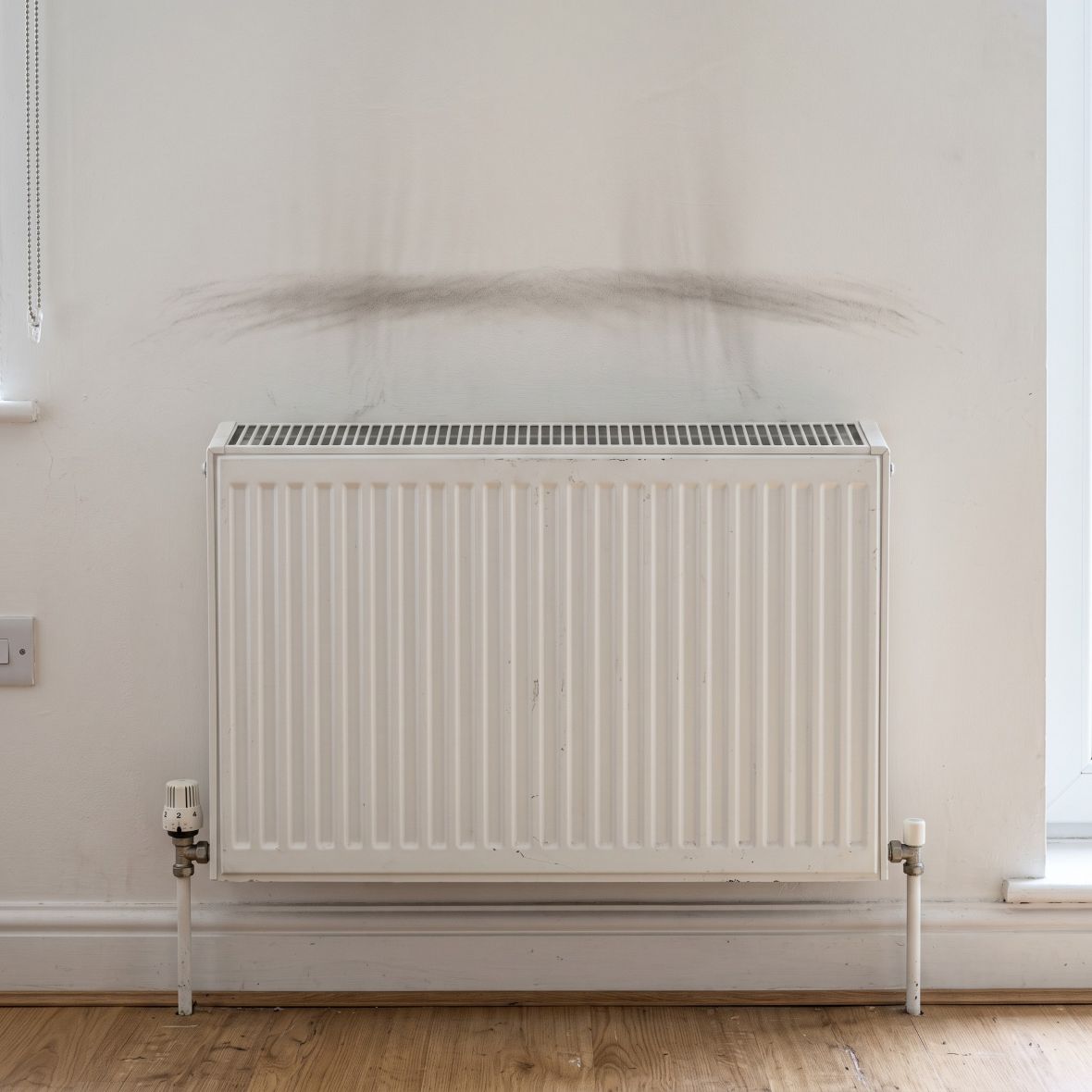
You’ve seen it. Grey-brown fans of dirt rising off the top of the radiator and spreading up the wall, darkest right above each convection channel, fading out somewhere around picture-rail height. Sometimes they’re so evenly spaced you’d swear someone had stencilled them.
Same story, every flat. And the reason I get asked about it in June rather than January is that people only notice when the heating’s been off long enough for them to look at the wall instead of stand in front of it.
Two jobs here, and they’re not the same job. Getting the dust out of the radiator is easy and takes eleven minutes. Getting the streaks off the wall above it is mostly impossible, and I’d rather tell you that at the top than sell you forty minutes of scrubbing that ends with you needing a decorator anyway.
Why is there a black stripe on the wall above your radiator?
Because a radiator is a pump, and you’re standing in what it’s pumping.
Cold air comes in at the floor, gets heated in the fins, and rises out of the top at a decent lick. That column of warm air carries everything the room has in it – skin cells, textile fibres from the carpet, cooking grease as an aerosol, soot from anything you burn, and whatever’s blown in off the road. The wall directly above is cooler than the air hitting it. Fine particles in a temperature gradient drift towards the cold side and stick there. Thermophoresis, if you want the word for it. Filtration soiling, if you’d rather the decorator’s term.
The wall is behaving like the filter in a vacuum. Air passes through and the dirt stays.
That’s why the marks line up with the channels, why they’re worse above the ends where the flow’s fastest, and why a wall in a flat where nobody smokes and nobody cooks stays clean for a decade while a wall two miles away goes grey in eighteen months. The physics is the same everywhere. What varies is what’s in your air.
Candles, and the thing nobody admits to
Paraffin candles are the single biggest cause I see, and people get defensive about it, which I find funny given the alternative explanation is usually worse.
A cheap jarred candle with a thick wick throws visible soot when it’s guttering, and a jar candle burnt down to the last inch is guttering the whole time. Burn two of those a night through a winter in a small Zone 2 living room and the radiator will lift every particle of it onto the wall for you and file it neatly by air current. Tea lights on a windowsill, same. Gas hob with a failing extractor, same. An open fire that doesn’t draw properly, worst of all.
I did a flat where the client swore blind it was the boiler putting soot into the room. It was forty quid a month of Diptyque and a door she kept shut.
What’s the fastest way to get dust out of a radiator?
Cold radiator, towel on the floor, hairdryer.
Turn the heating off a couple of hours beforehand – hot metal makes the dust cling and you’ll burn your knuckles on the pipework. Lay an old bath towel along the skirting, tucked right up under the radiator and out about half a metre, and dampen it. Damp is doing the work. A dry towel lets everything bounce off and go straight back into the room, which is how people end up sneezing for two days after cleaning a radiator and deciding they’re allergic to housework.
Then blow it out from the top with a hairdryer on cold, working left to right, one channel at a time. Everything comes out of the bottom and lands on the wet towel. Roll the towel up on itself before you lift it – don’t shake it out over the bath, that’s the whole point of the exercise gone.
After that, warm water with a splash of washing-up liquid on a microfibre wrapped round a wooden spoon handle or one of those long thin brushes, down each channel, twice. Dry it before you turn the heating back on, or you’ll bake a grey slurry onto the fins and it goes hard.
The towel goes underneath first
I’ve watched people vacuum a radiator with the crevice tool for twenty minutes and achieve almost nothing, because a vacuum only reaches what it can touch and most of the dust is on the vertical faces two inches in. The airflow method beats it every time. If you haven’t got a hairdryer, a can of compressed air works, and if you’ve got a leaf blower and no neighbours below you, that’s the professional version and it’s very satisfying.
Anything welded onto the fins has gone past dust – grease and time have got into it – and it needs the wet cloth and some patience.
Can you clean the streak off the wall, or is it paint?
Here’s the part people don’t want.
If the wall is matt emulsion, which in London flats it is about nine times in ten, you can’t clean it. Matt emulsion is porous. The soot has gone into the film, not onto it, and anything strong enough to lift it out is strong enough to take the binder with it. You’ll get a patch that’s cleaner than the streak and lighter than the rest of the wall, with a rubbed halo round it and a sheen where the vinyl’s been polished by the cloth. Three problems where you had one.
Sugar soap will do exactly this. So will magic sponges, which are fine abrasive blocks whatever the packaging says. So will the man who quotes you for a wall wash and is out of the door before it dries.
What does work: a chemical sponge, the dry rubber-latex kind sold for soot after a fire. It lifts loose surface deposit without water and without abrasion. On a lightly marked wall it might take you back to acceptable. On a proper streak it takes you from grim to slightly less grim, and then you’re painting.
Silk or eggshell, different answer. Wipes up fine, because there’s a film sitting on top for the dirt to sit on. Which is one reason I’d put eggshell above a radiator in any room where somebody burns anything.
The test on a bit nobody sees
Behind the sofa, or the strip of wall the curtain covers. Wet a cotton bud, roll it once on the paint, look at the bud.
Colour on the bud and no colour, it’s surface dirt and you might win. Colour on the bud and a lighter mark on the wall, stop – you’re removing paint, and every further pass makes the repair bigger. That’s a thirty-second test that saves people a weekend.
What about the covers, the valves and the gap behind?
Radiator covers are a mistake and I’d take them all to the tip.
They cut output by a chunk, they turn the space behind into a dust trap nobody has opened since the flat was sold, and the good ones – the MDF things with the grille – funnel the whole convection current straight up the wall in a narrower, faster column, which concentrates the ghosting instead of hiding it. People fit them to hide a stripe and make a stronger stripe eighteen inches higher.
If yours is screwed on, take it off once a year and clean behind it, and prepare yourself. Chatsworth Road, Clapton, E5, a couple of winters back: nice Victorian conversion, cover across the living-room radiator, previous tenant’s. Behind it was a felt of dust about the thickness of a beermat, two AA batteries, a cat toy, and a Christmas card postmarked 2016 addressed to somebody the client had never heard of. The cover came off, went in the van, and the room got warmer.
Why the cover is making it worse
The physics runs against you. A cover has to have a gap at the top for the air to leave through, and that gap is always narrower than the radiator is wide, so the same volume of air exits faster and in a tighter column. Faster air, more particles delivered per minute, one concentrated band across the wall rather than a soft spread. The grille also gives you a second filter to load up, and nobody cleans a grille. Take the cover off in October, look at the wall behind it, and you’ll see the stripe the cover was allegedly hiding – it’s there, it’s just been moved.
The gap behind the radiator itself: floss it. A length of old sheet, torn into a strip, fed down the back and worked side to side. Nothing else fits and every gadget sold for the job is worse than a rag.
How do you stop it coming back?
Burn less. That’s most of it, and it’s the bit people skip because it sounds like a lifestyle instruction rather than a cleaning tip.
Beeswax or rapeseed candles instead of paraffin, wicks trimmed to about five millimetres before every light, and nothing burnt down to the dregs in the jar. Extractor on before the pan goes on the hob, not after the smoke alarm. Vacuum the carpet properly rather than briskly, because carpet fibre is a huge share of what’s going up that wall.
Then the radiator itself, twice a year, before the heating goes on in autumn and once in the new year. Ten minutes each. Same story, every flat – the ones cleaned in October never develop the stripe at all, and the ones left until they’re grey are already a paint job.
The ten minutes in October
Diary it against the clocks going back, because that’s the only date anyone remembers. Heating off the night before, towel damp, hairdryer, done before the kettle’s boiled. The point of doing it then rather than in February is that the first three weeks of heating do most of the year’s damage – the radiator has a summer’s worth of dust in it, the wall is cold, and the first proper cold snap fires the lot upwards in one go. Clean it in February and you’re cleaning a radiator that’s already put its payload on your wall.
If you’re painting anyway, eggshell above the radiator, and leave a decent gap behind any furniture you push against that wall.
The Christmas card, by the way, went in the bin. I did check the name first.