
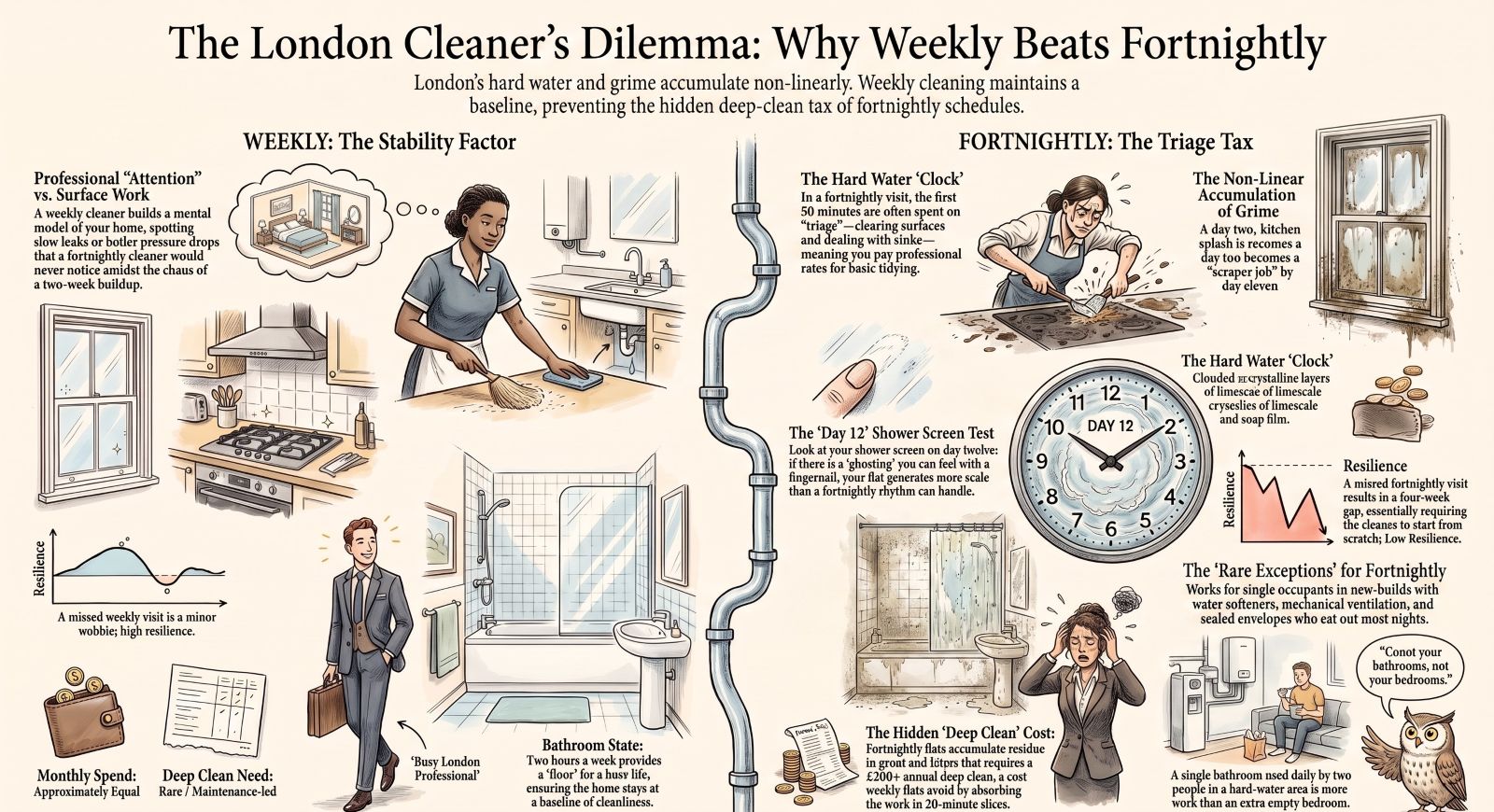
Weekly or Fortnightly Cleaner: Which Suits a Busy London Professional Better?
Nearly everyone rings me asking for fortnightly.
They’ve done the sum in their head on the walk back from the station and it looks obvious: half the visits, half the money, and the flat is only a one-bed anyway, and how dirty can one person get a place they’re barely in? Then they book three hours a fortnight, and by month four they’re texting to ask whether the cleaner could stay a bit longer because the bathroom never seems to come up as well as it did at the start.
Here’s my position, and plenty of people in my trade won’t say it out loud because fortnightly slots are easier to sell: for the overwhelming majority of London flats, two hours weekly beats four hours fortnightly at the same monthly spend, and it isn’t close. The second week is where the money goes. You pay for it twice – once in your own low-grade misery living in a flat that’s sliding, and again in the extra hour your cleaner needs to drag it back. That’s the maths.
There are flats where fortnightly is right. I’ll get to which ones. But the default has it backwards.
What changes in a flat between week one and week two?
Nothing much, and then everything at once.
Dust doesn’t work on a linear curve, whatever you’d expect. A flat in Zone 2 with sash windows onto a bus route picks up a visible film in about five days, and once there’s a film, footfall grinds it into the floor finish and it stops being dust and starts being a mark. Same with the kitchen. Splash on a hob wipes off in three seconds on day two. On day eleven it’s been baked on by six subsequent dinners and it’s a scraper job.
The bathroom is where the two-week gap bites hardest, and it’s the reason I keep having this argument. Limescale in London water forms crystalline layers, one on top of the last, and each layer traps the soap film and skin oil under it. Week one, that’s a wipe. Week two, you’re into acid and contact time, and if the flat’s on the hard side of the Lea Valley you’re into acid, contact time and a nylon pad. Something similar happens with the loo rim and the shower screen runners, where the deposit gets in under the seal and no amount of surface work reaches it.
The bathroom is the clock
Ignore the living room. If you want to know whether your flat can hold fortnightly, look at the shower screen after twelve days. If it’s got that ghosting you can feel with a fingernail, your flat is generating more limescale than the interval can absorb, and every visit from now on starts from a worse baseline than the last one. That drift is slow enough that people don’t see it happening. They just notice, eighteen months in, that the flat never feels properly clean any more and assume the cleaner’s gone off.
The cleaner hasn’t gone off. The cleaner is losing forty minutes a visit to work that shouldn’t exist.
Is fortnightly cheaper in the end?
Per visit, obviously. Per month, roughly the same, since you’ll end up booking longer sessions. Per year, no, and this is the bit people don’t cost.
Fortnightly flats need a deep clean. Not because anyone’s failing, but because the interval leaves residue that a standard visit is never scoped to remove – oven, grout, extractor filter, the underside of the kitchen cabinet doors where the handles are, the bit of skirting behind the bin. Weekly flats can absorb that work in twenty-minute slices across a quarter. Fortnightly flats can’t, so it accumulates until somebody books a one-off in April at deep-clean rates, and that’s a couple of hundred quid that never appears in the fortnightly-is-cheaper column.
Then there’s the rota problem, which is mine, not yours. A fortnightly slot is unstable. If your cleaner is ill or your Tuesday is a bank holiday, weekly means you miss one visit and you’re fine. Fortnightly means a four-week gap and you’re basically starting again. Every agency I know quietly prefers weekly clients because weekly clients don’t ring up in a state.
The hour you pay for twice
Run it properly. Take a two-bed flat, two working adults. Weekly at two and a half hours means the cleaner arrives to a flat that’s already close to baseline and spends the whole session on actual cleaning. Fortnightly at four hours means the first fifty minutes are triage – clearing surfaces, dealing with the sink, getting the bathroom back to a state where cleaning can begin. You’re paying professional rates for tidying. That’s the maths, and it’s why the fortnightly flats I go into look worse on the day I leave than the weekly ones.
Which London flats can actually hold a fortnightly rhythm?
Some can. I’m not pretending otherwise.
One person, no pets, no smoker, no builders next door, works in an office four days and eats out most nights, modern flat with good windows and a decent extractor, carpet only in the bedroom, no hard-water hell in the shower because there’s a softener in the block. That flat will sit at fortnightly for years and be perfectly pleasant. New-build blocks around Millharbour on the Isle of Dogs do this well – sealed envelope, mechanical ventilation, nothing coming in off the street.
Everyone else is kidding themselves. And I include in that the person reading this who has just decided their flat is the exception because they’re never home. Being never home is not the variable. The flat carries on being a flat whether you’re in it or not – the water still evaporates out of the U-bends, the dust still lands, the fridge seals still do what fridge seals do in a warm kitchen. Dog: weekly, and I’d argue for more. Toddler: weekly. Two flatmates on opposite shifts: weekly, because a flat with somebody always in it never gets a fallow day. Anyone who cooks properly more than twice a week: weekly, because a real kitchen produces aerosolised fat and that fat lands on every horizontal surface within about two metres and turns dust into a film that has to be dissolved rather than lifted.
The Islington job that changed my mind
Flat on Rheidol Terrace, N1, a couple of years ago. Solicitor, mid-thirties, out at seven back at nine, absolutely convinced she barely used the place and therefore needed me once a fortnight for three hours. Three visits in, I told her the flat wasn’t holding and she thought I was upselling her. Fair enough – I would have thought that too.
So we ran it her way for a full quarter and I kept a note each visit of what I couldn’t get to. By March the list had the oven glass, the grout in the shower, both extractor filters, the top of the kitchen units, and the inside of the fridge door seals, which were going black. She’d hardly cooked all winter. What she had was a Nespresso machine, a gym habit that produced a laundry rack of wet kit in the living room, and a cat.
We moved to weekly at two hours for the same money. Nine weeks later she said the flat felt like a different flat, which it was, because it was now getting attention before things set rather than after. I still go. The cat still hates me.
What does weekly buy you that fortnightly can’t?
Attention, and I mean that as a technical term.
A cleaner who’s in your flat every week knows what’s normal. She’ll spot the slow leak under the sink because the cupboard base looks two shades darker than last Thursday. She’ll notice the boiler pressure gauge has dropped. She’ll clock that the mould in the bedroom corner has come back before you do, because you sleep in that room and you’ve stopped seeing it. Fortnightly cleaners never build that model. Too much changes between visits for anything to stand out.
The other thing weekly buys is a floor under your bad weeks. Everyone in London has a fortnight now and then where the job eats everything. On weekly, that fortnight costs you nothing structurally – the flat wobbles and comes back. On fortnightly, one bad stretch plus one missed visit is a month, and a month is a deep clean.
What to do in the four days after a visit
Nothing much, and that’s the point of paying for it. But two things hold a weekly rhythm almost by themselves: squeegee the shower screen when you get out, which takes eleven seconds, and don’t let anything live on the hob overnight. Those two habits are worth about half an hour of professional time a week. Everything else – the wiping, the bleaching, the ritual Sunday panic – you can drop entirely.
So how do you choose between them?
Count your bathroom, not your bedrooms.
One bathroom that two people shower in daily, in a London water area, is more work than an extra bedroom nobody enters. Then count pets, then count how many evenings a week the hob gets used, then look at the shower screen on day twelve and be honest about what you see. If it’s furred, fortnightly is a decision to live slightly grubbily and pay a deep-clean tax in the spring. Which some people are fine with, and I’ve no argument with anyone who’s made that choice on purpose.
The question to ask an agency before you book
Ask what they’d recommend for your flat, and then ask what their fill rate looks like on Tuesdays. A firm with gaps will happily sell you fortnightly and put someone else in the other week. A firm that’s busy will tell you the truth, because they don’t need your alternate Tuesday and they’d rather have a client whose flat doesn’t fight them. Ask, as well, whether the hourly rate changes with frequency. Most decent outfits price weekly lower per hour than fortnightly, and if yours doesn’t, that tells you something about how they’ve scoped the work. It’s the clearest signal you’ll get without a trial run, and a trial run costs you a month.
It’s the ones who think they’ve chosen the cheaper option that I end up correcting eighteen months late, usually while scraping something off an oven door.